
Criminal Cases in Christian County Courts
Christian District Court and Christian Circuit Court share one records custodian, but their criminal roles differ. District Court hears misdemeanors, violations, and many traffic matters. It also handles warrants, initial appearances, bond decisions, and the first phase of felony cases. Circuit Court is the felony trial court. It receives indictments and keeps the later felony record of pleas, motions, trials, judgments, and sentences. Kentucky law assigns District Court its limited criminal jurisdiction under KRS 24A.110, while KRS 23A.010 establishes Circuit Court's general jurisdiction.
The elected Office of Christian Circuit Court Clerk maintains files for both courts. That title often causes confusion. A misdemeanor record is still requested from the Circuit Court Clerk even though District Court heard the case. One felony event may also carry a District case number for its early proceedings and a Circuit number after indictment. Searchers should ask about both numbers before concluding that part of the file is missing.
Christian County Court Case Routing
The charge level is the best first clue to where a Christian County criminal case file sits. A misdemeanor generally remains in District Court from arraignment through disposition. A felony starts there for its first appearance and preliminary work, then moves to Circuit Court after an indictment or other authorized charging action. City ordinance prosecutions from Hopkinsville, Oak Grove, or Pembroke also enter Kentucky's unified court structure. Those cities do not maintain separate public criminal-case portals.
The Christian County Court of Justice page identifies the clerk, court divisions, judges, and local contact channels. Its view of the Justice Center also shows the public building where records are requested.
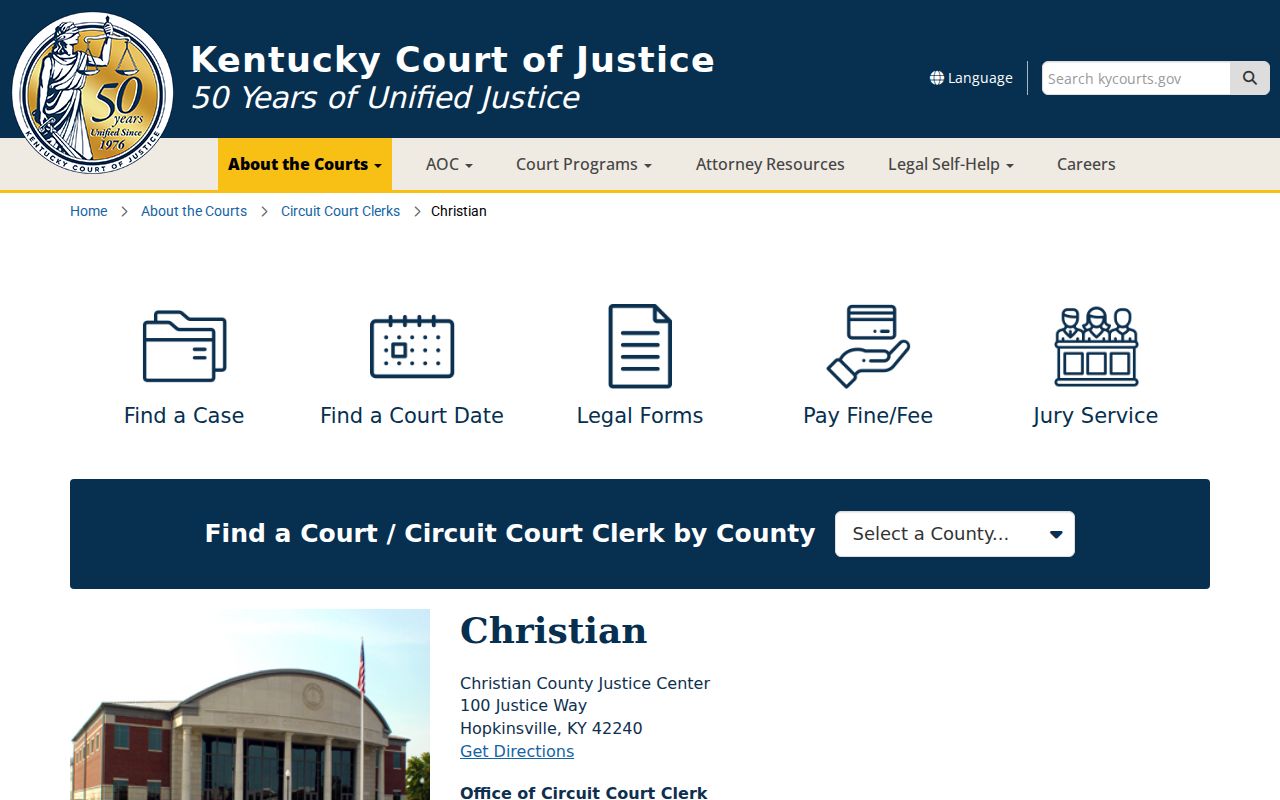
The image ties the two trial courts to one Hopkinsville records counter, helping prevent requests from going to a city office or the county clerk's land-record division.
How to Search Case Records
Start locally when the goal is the full docket or a filed document. The clerk can distinguish District from Circuit numbers and explain whether a file is on site. A statewide AOC report is useful for checking court activity across Kentucky's 120 counties, but it is a compiled summary, not a copy of the Christian County case file. Full CourtNet 2.0 access is an authorized-user or subscription service, so it should not be mistaken for a free public docket search.
- Call, email, or visit the Christian County clerk with a case number, if known.
- Otherwise provide the full name, aliases, approximate birth date, charge, and filing year.
- Ask whether both District and Circuit case numbers exist for the same event.
- Obtain the docket, then identify the charging paper, disposition order, and sentence needed.
- Request a certified copy only when authentication is required, since certification may add cost.
The clerk publishes ChristianCoCircuitClerk@kycourts.net for record questions and the phone lines 270-889-6539, 270-889-6541, 270-889-6542, and 270-889-6592. Email can establish procedure and availability. Avoid sending Social Security numbers or other unneeded sensitive data.
| Search input | Type | Use | Christian County note |
|---|---|---|---|
| County | Filter | Local scope | Select Christian |
| Court or case type | Filter | Optional | Choose Circuit Criminal or District Criminal |
| Case number | Text | Best exact key | Usually includes year, type, and sequence |
| Last and first name | Text | Name search | Search aliases or former names separately |
| Date of birth | Date | Identity match | Strongest discriminator for common names |
| Filing range or status | Filter | Optional | Narrow by year, open, or disposed status |
Christian County Court Reports Versus Files
AOCFastCheck and the One-Time Request channel answer a different question from the clerk's copy counter. They produce statewide criminal court-record reports drawn from CourtNet. The public can order a report on another person, and the result may cover felonies dating to 1978 plus misdemeanor and traffic cases for at least the prior five years. Confidential juvenile, mental-health, domestic-violence, expunged, and purged matters are excluded. Current price and transaction terms should always be checked on the official screen.
The AOCFastCheck public menu shows the account-based report channel and the separate one-time path.
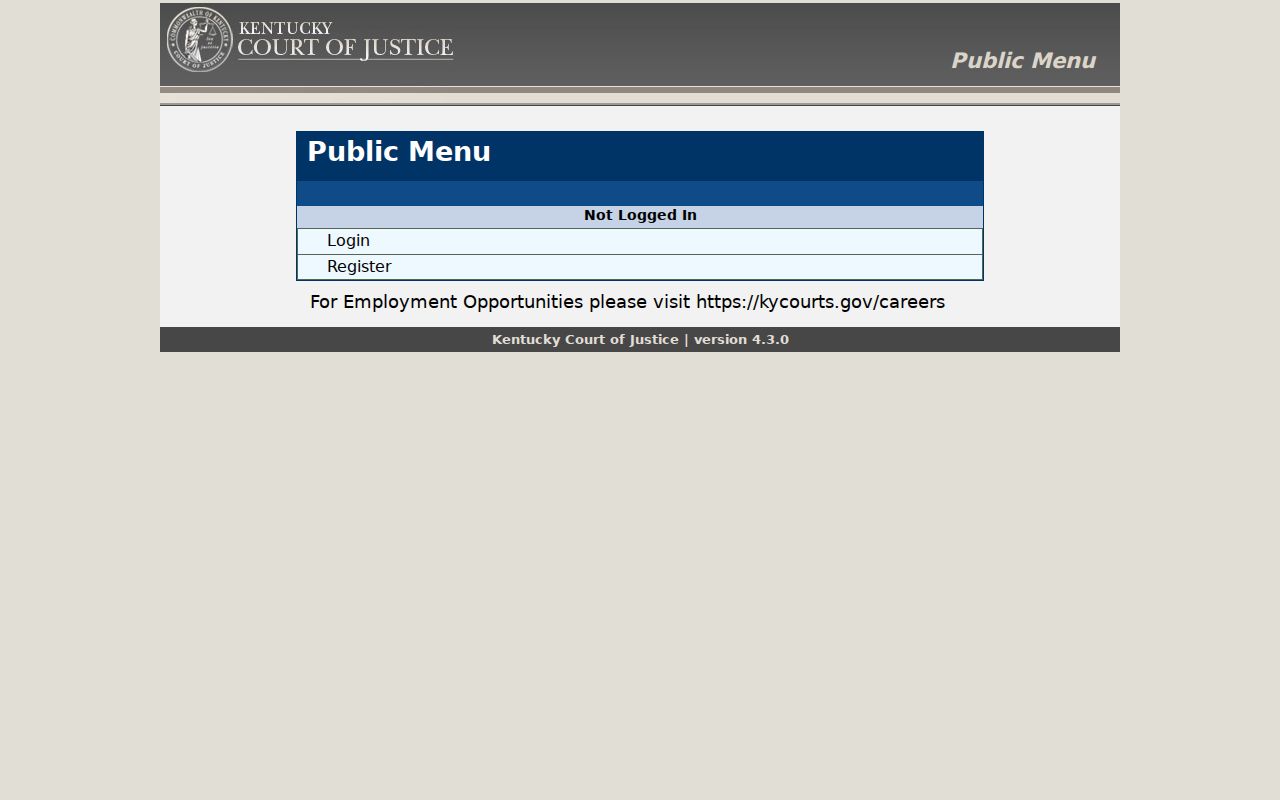
This interface is best used to find broader Kentucky court activity. Return to the Christian County clerk for the indictment, motion, judgment, or another underlying document.
What the Case File Shows
A Christian County criminal case file links each court event to its source document. The docket is the chronological index. It may identify counsel, bonds, warrants, hearing dates, motions, orders, and the final result, while the charging document states the allegations and Kentucky statute cited. Read at the charge level because separate counts can end differently. A disposed case is merely concluded. The word does not prove a conviction.
| Case Number & Court | Identifies Christian District or Circuit Court, filing year, case type, and sequence. |
|---|---|
| Charging Document | Shows the complaint, citation, information, or indictment and the original charge. |
| Docket Entries | Lists filed motions, orders, counsel, bond activity, warrants, and other events. |
| Hearing Dates | Records scheduled and completed appearances, including hearing type, date, and time. |
| Disposition & Judgment | States whether each count was dismissed, amended, acquitted, or ended in conviction. |
| Sentence & Conditions | May show custody, probation, conditional discharge, fines, restitution, costs, and concurrent or consecutive terms. |
Protected identifiers are not public, and electronic images may require authorized access or carry fees. If the summary is unclear, request the actual judgment, sentence, or order rather than inferring an outcome from a short status label.
Read Christian County Case Dispositions
Disposition terms carry precise but limited meanings. “Dismissed” means no conviction on that charge, though the docket may show that dismissal as part of a plea on another count. “Acquitted” is a not-guilty adjudication. “Convicted” follows a guilty plea or verdict and should connect to a judgment and sentence. An “amended” entry means the filed charge changed, so compare the original and final KRS citations. A “no bill” means the grand jury did not return an indictment.
Diversion needs more than a label. It signals conditional processing, and the governing order plus the completion entry supply the final meaning. The same care applies to probation revocation, later sentence modification, an appeal, or expungement. Those post-judgment events can change the practical status long after the first disposition was entered. When a dismissal appears in court but not in a separate arrest or repository file, obtain the final certified order and take it to the custodian of the stale record.
Stages of a Criminal Case
The Christian County court trail grows one event at a time. A citation, complaint, or arrest first creates the District Court paper trail. Initial appearance addresses identity, charges, counsel, custody, and release. In a felony matter, prosecutors and the grand jury determine whether an indictment will issue. Circuit arraignment records the felony plea. Pretrial motions, discovery disputes, continuances, and bond hearings then add docket entries and orders before the case reaches a plea, dismissal, acquittal, or trial verdict.
Case flow: Charges Filed › Arraignment › Pretrial › Plea or Trial › Disposition › Sentencing
Sentencing may record incarceration, probation or conditional discharge, fines, restitution, costs, and whether terms run at the same time or in sequence. Later records may document revocation, appeal, modification, or expungement. The full chain matters because an early accusation and a final judgment answer very different questions.
Older Christian County Court Case Files
A case absent from an online result may still exist. Kentucky court files follow retention schedules, and some older Christian County records are stored away from the Justice Center. Ask the clerk to locate the case first. If the file is at the State Records Center, obtain both the case number and locator number before contacting state.records@ky.gov or 502-564-3617. That center cannot run a name or Social Security number search. Kentucky Department for Libraries and Archives material should also be pursued only after the clerk gives routing details.
The Kentucky Court of Justice record-request instructions explain why the county clerk remains the starting point even when storage has moved.
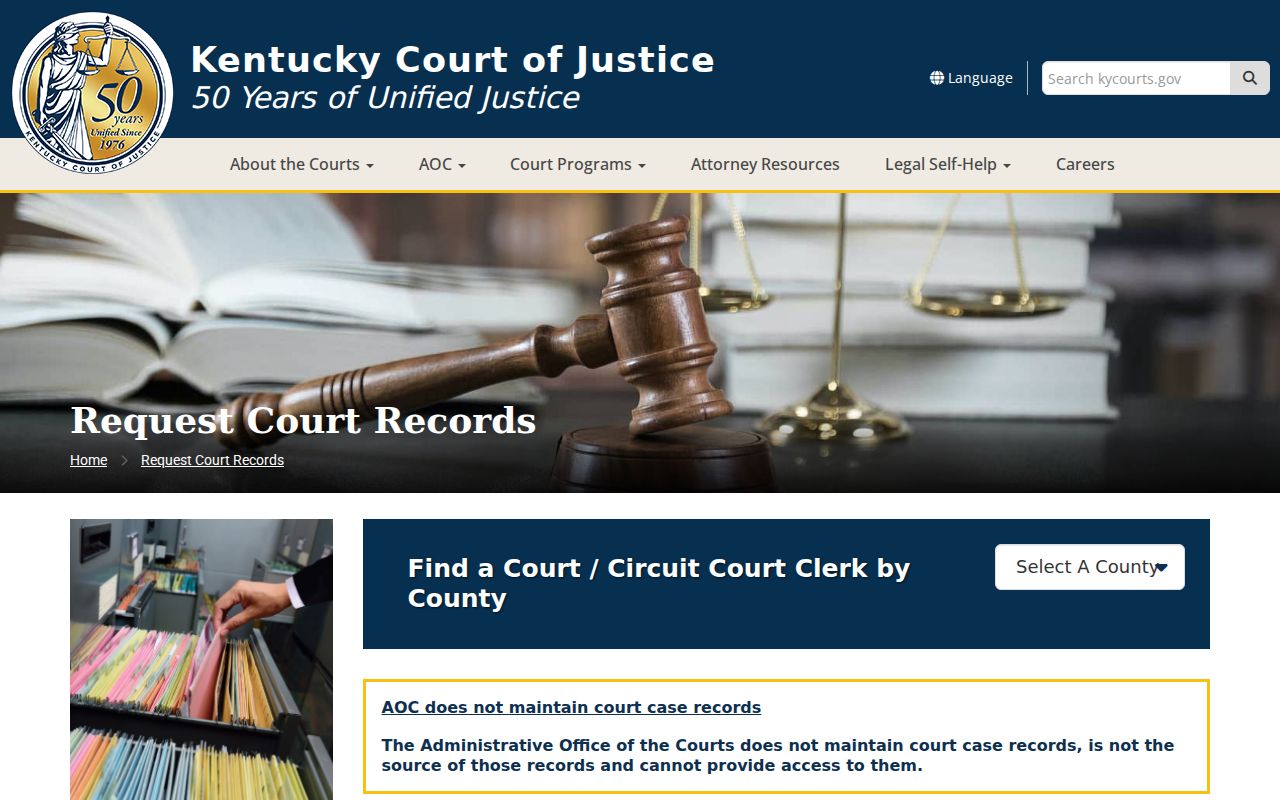
The request page reinforces the practical rule: secure the correct court and locator details before contacting an archive, then specify the exact docket or document needed.
Access & Restrictions
Court case access begins with the judicial branch, not a general county Open Records Act request. KRS 26A.200 addresses judicial records and expunged information. AOC's administrative-record policy does not replace the clerk process for an individual District or Circuit case. For ordinary public files, call or visit the Justice Center counter at 100 Justice Way, Hopkinsville, Kentucky 42240. The office lists weekday hours of 8 a.m. to 4:30 p.m. and accepts cash, money order, and cards, with a fee for card use.
Juvenile proceedings, protected victim or minor details, Social Security numbers, financial-account data, sealed matters, and sensitive electronic images may be withheld, redacted, or limited to entitled participants. Expunged cases do not appear in ordinary public CourtNet access. Missing material can also reflect an old file, a reporting delay, or a search mismatch rather than sealing. Ask the clerk which condition applies instead of assuming the reason.
Christian County Appeals and Federal Cases
Appeals and federal prosecutions require separate searches. Kentucky appellate dockets are available through C-Track Public Access. Trial-court filings still come from the Christian County clerk, while the appellate docket shows the later review. A federal prosecution arising in Christian County belongs to the U.S. District Court for the Western District of Kentucky. It will not appear in a state AOC criminal-record report.
The official PACER service provides federal case-locator, docket, and document access after registration.
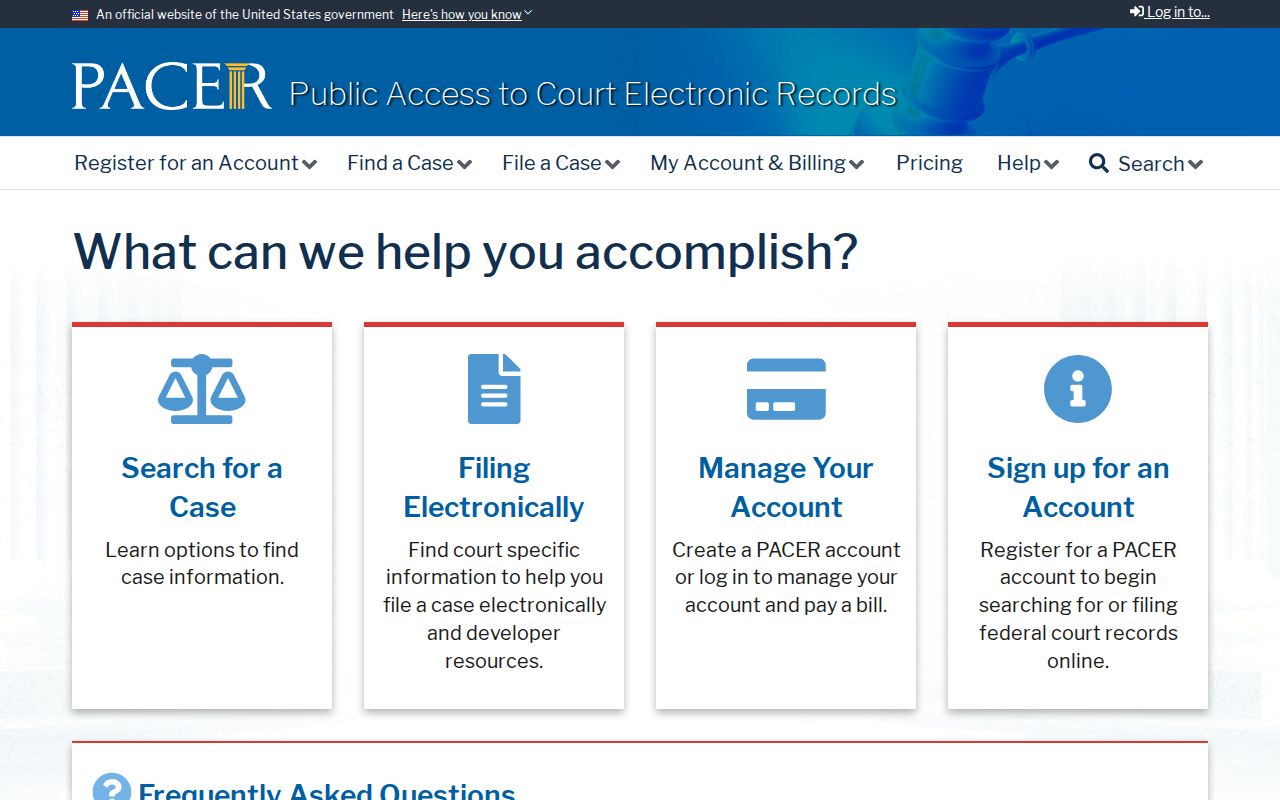
PACER charges under its published fee schedule, subject to its document cap and quarterly waiver threshold. Verify current rates there, then use the federal docket for filed charges, hearings, motions, orders, judgment, and appeal links.